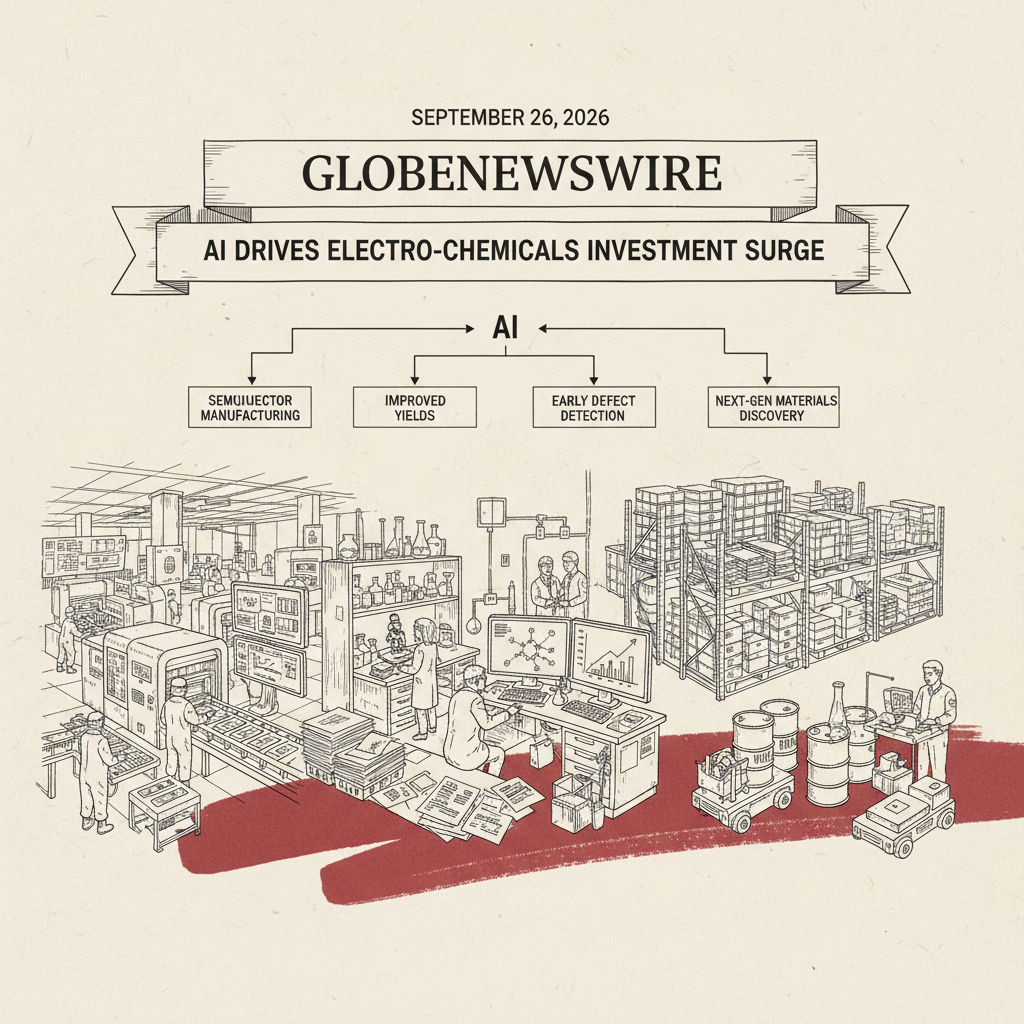
The electronic chemicals and materials industry is experiencing an investment surge driven by Artificial Intelligence (AI). This development was reported by GlobeNewswire on September 26, 2026. AI is assisting semiconductor manufacturers in improving yields, detecting defects earlier, and accelerating the discovery of next-generation materials.
The details
AI's application in the electronic chemicals and materials sector focuses on operational and developmental improvements. Semiconductor makers are leveraging AI to enhance manufacturing processes. This includes optimizing production efficiency to achieve higher yields. The mechanism involves AI algorithms analyzing vast datasets from manufacturing lines, identifying patterns, and predicting optimal parameters for chemical reactions, deposition processes, and material treatments. This data-driven optimization reduces waste and increases the number of usable chips produced from a given wafer.
AI also contributes to quality control by enabling earlier detection of defects in materials and components. Traditional defect detection often relies on human inspection or rule-based automated systems, which can be slow or miss subtle anomalies. AI, particularly machine vision and deep learning, can process images and sensor data from various stages of production at high speed and with greater accuracy, identifying microscopic flaws or inconsistencies that could lead to device failure. This early detection prevents defective materials from progressing further in the manufacturing chain, saving resources and time.
Furthermore, AI is being used to speed up the research and development of new materials, which are critical for future electronic devices. The discovery of novel electronic chemicals and materials is a complex, time-consuming process involving extensive experimentation. AI can simulate material properties, predict molecular structures with desired characteristics, and guide experimental design, significantly shortening the discovery cycle. This accelerates the development of materials required for advanced computing, memory, and communication technologies.
This AI-driven investment is part of a broader trend. Corporate AI spending in 2026 helped mitigate some global economic impacts from the Middle East energy shock, according to the OECD. This spending created a capital wave, contributing to a lifted 2026 growth forecast by the OECD. The United States' AI investment is projected to reach $10.3 trillion, surpassing historic railroad spending. This substantial outlay is expected to reshape the economy. This level of investment signifies a fundamental shift in capital allocation towards AI infrastructure and applications across various sectors.
Why it matters
The integration of AI into the electronic chemicals and materials industry indicates a shift in manufacturing and R&D paradigms. The ability to improve yields directly impacts production costs and efficiency for semiconductor manufacturers. Higher yields mean more functional chips per wafer, leading to lower per-unit costs and increased profitability. This mechanism supports the scaling of semiconductor production, which is crucial for meeting the growing demand for AI hardware itself.
Early defect detection reduces waste and improves product reliability. By catching defects at an earlier stage, manufacturers avoid investing further resources into faulty components, leading to significant cost savings. The improved reliability of electronic components, in turn, enhances the performance and longevity of end products, from consumer electronics to critical infrastructure.
Accelerated material discovery can shorten development cycles for new technologies, bringing advanced products to market faster. This is a second-order effect that fuels innovation across the entire technology ecosystem. Faster material innovation enables the creation of more powerful processors, denser memory, and more efficient energy solutions, which are foundational to advancements in AI, quantum computing, and other emerging fields. This market mechanism supports the broader technology sector by providing more efficient and innovative foundational components.
This surge in AI-related capital spending is also drawing attention to markets such as KOSPI, as reported by Simply Wall Street on September 27, 2026. Companies like Samsung Electronics and SK Hynix are increasing data center spending. This increased capital expenditure by major technology firms directly drives demand for the electronic chemicals and materials used in manufacturing the components for these data centers, creating a positive feedback loop for the industry. Taiwan Semiconductor Manufacturing Company (TSMC) is a central beneficiary of the AI-driven capital expenditure surge, according to Seeking Alpha on September 26, 2026. Hyperscalers' spending is projected to reach $1.3 trillion in 2027. This massive investment by hyperscalers, which are large cloud service providers, underscores the foundational role of advanced semiconductors and, by extension, the electronic chemicals and materials required to produce them.
What to watch
Future reports from the OECD will provide updated forecasts on global growth, which may offer further insights into the impact of AI spending. The OECD lifted its 2026 growth forecast based on AI spending, but warned that the 2027 outlook is darkening, as reported by CryptoRank on September 25, 2026. This suggests that while AI investment provides a near-term economic boost, there may be underlying economic pressures or potential over-investment risks that could affect future growth. Monitoring these forecasts will be critical for understanding the sustainability and broader economic implications of the current AI-driven capital expenditure. The continued investment by major players like Samsung, SK Hynix, and hyperscalers, and its impact on semiconductor manufacturing leaders like TSMC, will serve as key indicators of the ongoing transformation within the electronic chemicals and materials sector. The scale of projected US AI investment, exceeding historical infrastructure projects, also warrants close observation for its long-term economic and societal reshaping effects.
Sources
- AI-Driven Investment Surge Reshapes the Electronic Chemicals and Materials Industry — GlobeNewswire
- 3 KOSPI AI Infrastructure Stocks Riding Samsung And SK Hynix Data Center Spending — Simply Wall Street
- Taiwan Semiconductor: AI CapEx Keeps Climbing, And TSMC Looks Undervalued (NYSE:TSM) — Seeking Alpha
- US AI Investment Surpasses Historic Railroad Spending — 조선일보
- OECD lifts 2026 growth forecast on AI spending, warns 2027 outlook is darkening — CryptoRank
Valencia Cross publishes research and commentary for informational purposes only. Nothing here is investment advice. Verify every figure against the linked primary sources.