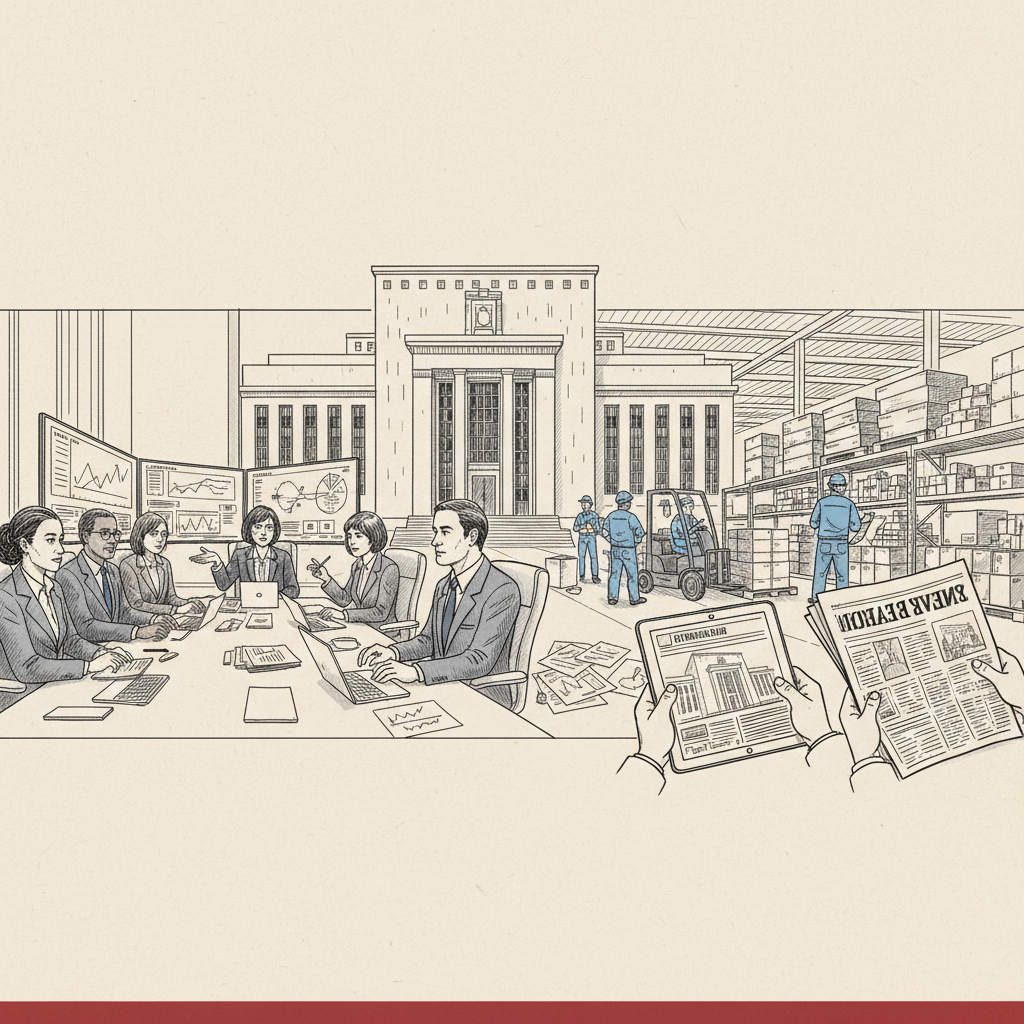
The Federal Reserve increased interest rates on September 19, 2026. This decision came amid renewed inflation concerns and an increase in long-term interest rates. The Federal Reserve's decision was unanimous, according to LBM Journal.
The details
The Federal Reserve raised its benchmark interest rate by 25 basis points, moving the target range to 3.75%-4.00%. This marks the first rate hike by the Federal Reserve since 2023. The Federal Open Market Committee (FOMC) voted 12-0 in favor of the increase. This unanimity reflects a strong consensus among policymakers regarding the necessity of the action in the current economic environment. The decision highlights the central bank's focus on managing inflation, which remains a primary concern. Kevin Warsh, a former Federal Reserve governor, warned that inflation remains too high, indicating that the fight against rising prices is not yet concluded. The Federal Reserve also signaled that more rate increases are expected in the future. This forward guidance indicates a continued hawkish monetary policy approach, aiming to further cool economic activity and bring inflation back to the central bank's target. The mechanism behind a rate hike involves increasing the cost of borrowing for commercial banks, which then translates into higher interest rates for consumers and businesses on loans such as mortgages, auto loans, and credit cards. This aims to reduce demand in the economy, thereby alleviating inflationary pressures.
Why it matters
The Federal Reserve's rate hike directly impacts market dynamics and broader economic conditions. Following the decision, U.S. Treasury yields fell. This decline suggests that the market interpreted the Fed's action as a credible commitment to controlling inflation, thereby regaining trust in the central bank's resolve. When Treasury yields fall, it can indicate that investors expect future economic growth to slow, or that they anticipate inflation will be brought under control, making fixed-income assets relatively more attractive. Concurrently, the Bank of England (BOE) kept its policy rate unchanged at 3.75%, a decision that was widely expected. This decision followed the Federal Reserve's rate hike, illustrating how central banks in major economies may respond to or diverge from each other's monetary policy actions based on their respective domestic economic conditions.
Commodity markets also reacted to the anticipation of the Fed's decision. Gold (XAU/USD) showed signs of short-term weakness ahead of the Federal Reserve's announcement, accumulating a decline of nearly -2.4% over four trading sessions. This indicates gold's sensitivity to central bank actions and expectations of higher interest rates, which typically increase the opportunity cost of holding non-yielding assets like gold.
The Federal Reserve's actions, while focused on monetary policy, operate within a broader fiscal context. The U.S. federal debt has surpassed $40 trillion. While the Federal Reserve's mandate is price stability and maximum employment, the scale of the national debt raises questions about its implications for long-term fiscal programs such as Social Security and Medicare. The cost of servicing this debt can increase with higher interest rates, potentially diverting resources from other government expenditures. However, the Federal Reserve's actions are separate from these fiscal challenges, which fall under the purview of Congress and the Treasury Department.
Global economic factors also influence and are influenced by the Fed's policy. JPMorgan stated uncertainty regarding the oil outlook, even with crude oil prices potentially reaching $100 per barrel and interest rates at 5%. This uncertainty is attributed to geopolitical factors, including situations in the Hormuz Strait, Red Sea, and Saudi Pipeline regions, as well as Russia's refining capacity. The Federal Reserve's rate hikes aim to cool economic activity, which could, as a second-order effect, reduce global energy demand. However, the impact of monetary policy on commodity prices can be complex and often overshadowed by supply-side geopolitical risks. In a separate development, the Nigerian government and the Central Bank of Nigeria formalized a coordination framework for public borrowing, treasury management, and liquidity. These are domestic policy actions by a sovereign nation, distinct from the Federal Reserve's international impact, but they highlight the global trend of governments and central banks coordinating fiscal and monetary policies to manage national economies.
What to watch
Market participants will closely monitor future statements from the Federal Reserve for indications of further policy direction and economic outlook. Any new inflation data, particularly the Consumer Price Index (CPI) and Personal Consumption Expenditures (PCE) price index, will be relevant in assessing the effectiveness of current policies and guiding future decisions. Changes in long-term interest rates, such as the yield on the 10-year U.S. Treasury note, will also be observed as indicators of market expectations regarding inflation and economic growth. The Federal Reserve has signaled that more rate hikes are to come. Future announcements and speeches from FOMC members will clarify the timing and magnitude of these potential increases, providing critical insights into the central bank's commitment to achieving its inflation targets and maintaining economic stability.
Sources
- Fed Hikes Rates, Signals More to Come — LBM Journal
- U.S. Debt Tops $40 Trillion – What It Could Mean for Social Security and Medicare — Capitol Skyline
- Gold Forecast XAUUSD loses strength ahead of the Fed decision — www.stonex.com
- Fed hikes rates to 4% as Warsh signals inflation fight is not over — www.equiti.com
- U.S. Treasury Yields Fall as Fed Regains Trust, BOE Leaves Rates Unchanged — WSJ
Valencia Cross publishes research and commentary for informational purposes only. Nothing here is investment advice. Verify every figure against the linked primary sources.