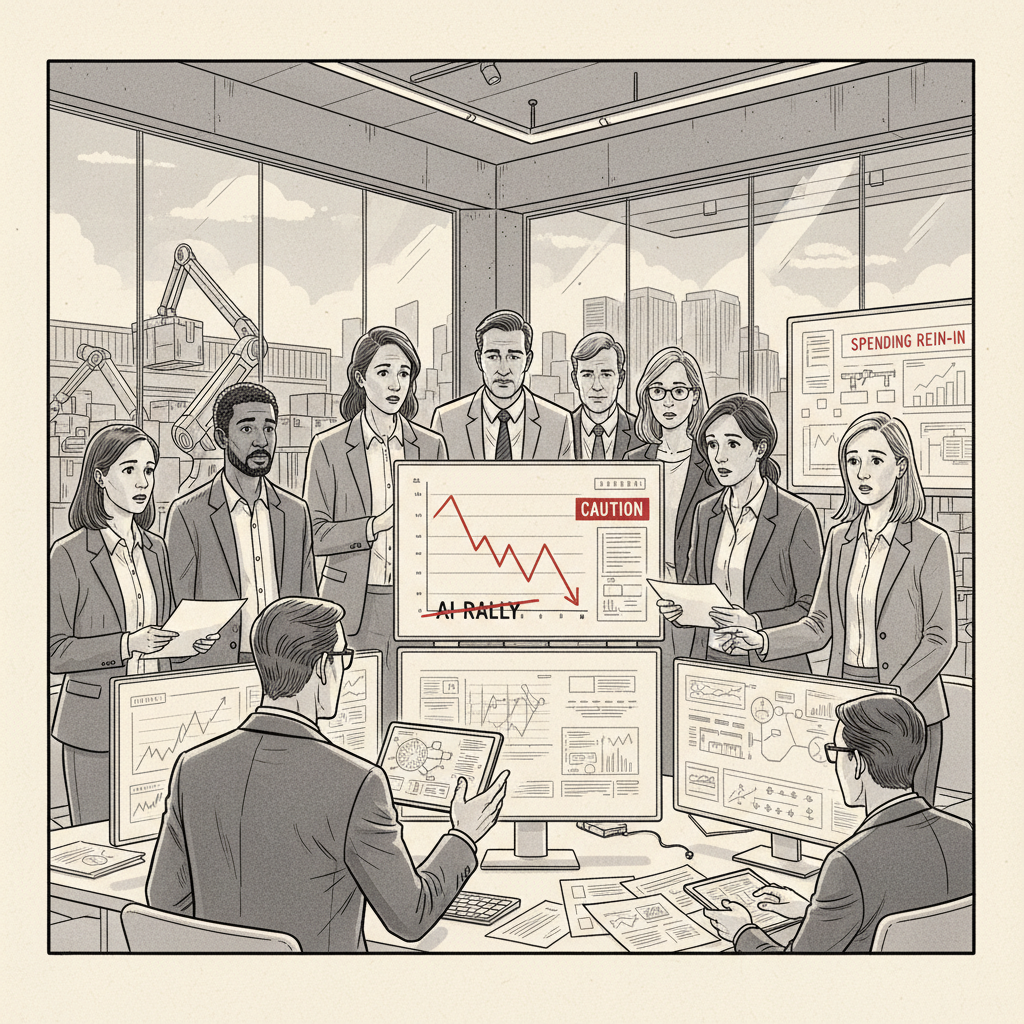
Investors are showing nervousness regarding the stock market's AI-led rally. This follows warnings from industry leaders who called for reining in spending. Reuters reported this development on September 15, indicating a shift in market sentiment after a period of significant AI-driven growth.
The details
Industry leaders urged caution on frontier AI models. This sparked fears that spending on AI data centers may slow. These concerns are not isolated; AI stocks subsequently slid, according to Seeking Alpha, reflecting immediate market reaction to these warnings. The underlying mechanism for this caution appears to be a disconnect between the investment in AI infrastructure and its current revenue generation. Specifically, the Walter Bradley Center for Natural and Artificial Intelligence reported that paid usage of AI models has not risen sufficiently to cover falling token prices. This suggests that while the computational demands for AI models are high, the monetization of these models is not yet robust enough to sustain the current pace of investment and infrastructure build-out.
The concept of 'frontier models' refers to the most advanced and resource-intensive AI systems, which require substantial computational power and, consequently, significant data center investment. The call for caution on these models directly impacts the demand for new data center capacity and the associated hardware. The slowdown in AI data center spending is a direct consequence of this re-evaluation of return on investment in advanced AI development. This situation creates a feedback loop: if revenue growth from AI applications does not meet expectations, companies may reduce their investment in the underlying infrastructure, which then impacts the entire supply chain supporting AI development.
Why it matters
The potential slowdown in AI data center spending carries significant economic implications, extending beyond the immediate tech sector. Goldman Sachs estimates that approximately two-thirds of a data center's value ultimately flows to equipment producers in Asia. This statistic highlights the global nature of the AI supply chain and the potential for a slowdown to have widespread international effects. A reduction in data center construction or upgrades would directly impact these Asian equipment producers, potentially leading to decreased orders, reduced manufacturing activity, and broader economic deceleration in those regions.
Companies like Teradyne are directly exposed to these trends. Teradyne is currently in a multiyear growth phase, driven specifically by the build-out of AI infrastructure. The company's Semi Test and Robotics groups are capturing this demand, indicating their reliance on continued investment in AI-related hardware and testing capabilities. A deceleration in AI infrastructure spending would likely temper Teradyne's growth trajectory, affecting its revenue and profitability. This illustrates a second-order effect: the initial caution from AI industry leaders translates into reduced demand for specialized components and services, impacting companies far down the supply chain.
Furthermore, the investor nervousness indicates a potential shift in market sentiment regarding the sustainability of current AI-driven growth. For an extended period, AI has been a primary catalyst for stock market rallies, with significant capital flowing into companies perceived to be leaders or beneficiaries of the AI revolution. If investors begin to question the fundamental revenue generation capabilities of AI models or the pace of infrastructure expansion, it could lead to a broader re-evaluation of tech stock valuations. This re-evaluation might not be limited to AI-specific companies but could extend to the broader technology sector, particularly those firms whose growth narratives are heavily tied to AI adoption and expansion. The market's reaction to industry warnings suggests that the previous enthusiasm for AI may be giving way to a more cautious, fundamentals-driven assessment of its economic impact.
What to watch
Future company earnings reports and industry guidance will provide further clarity on AI spending trends. Specific attention should be paid to the capital expenditure (CapEx) plans of major hyperscalers and AI developers, as these directly influence data center construction and equipment demand. Statements from semiconductor manufacturers and data center infrastructure providers will offer insights into order backlogs and future projections. Additionally, monitoring the revenue growth reported by companies offering AI models and services will be crucial to assess if paid usage begins to align more closely with the investment in underlying infrastructure. Any shifts in government policy or regulatory frameworks concerning AI development and deployment could also influence spending patterns. The trajectory of token prices and the profitability margins for AI model usage will serve as key indicators of the industry's financial health and its capacity for sustained growth. These factors will collectively inform whether the current nervousness evolves into a prolonged slowdown or if the industry finds new avenues for sustainable revenue generation to support continued investment.
Sources
- Analysis-Investors nervous about AI spending slowdown after industry warnings — WKZO
- AI slowdown fears hammer data-center power and construction stocks (GEV:NYSE) — Seeking Alpha
- “AI Doomsday” Talk Distracts Us From Lack of Revenue Growth — Walter Bradley Center for Natural and Artificial Intelligence
- Asia’s AI Dividend Is Spreading Beyond the Factory Gate — The Dark Side Of The Boom
- TER Stock: The Math Hidden In Its Price — Trefis
Valencia Cross publishes research and commentary for informational purposes only. Nothing here is investment advice. Verify every figure against the linked primary sources.