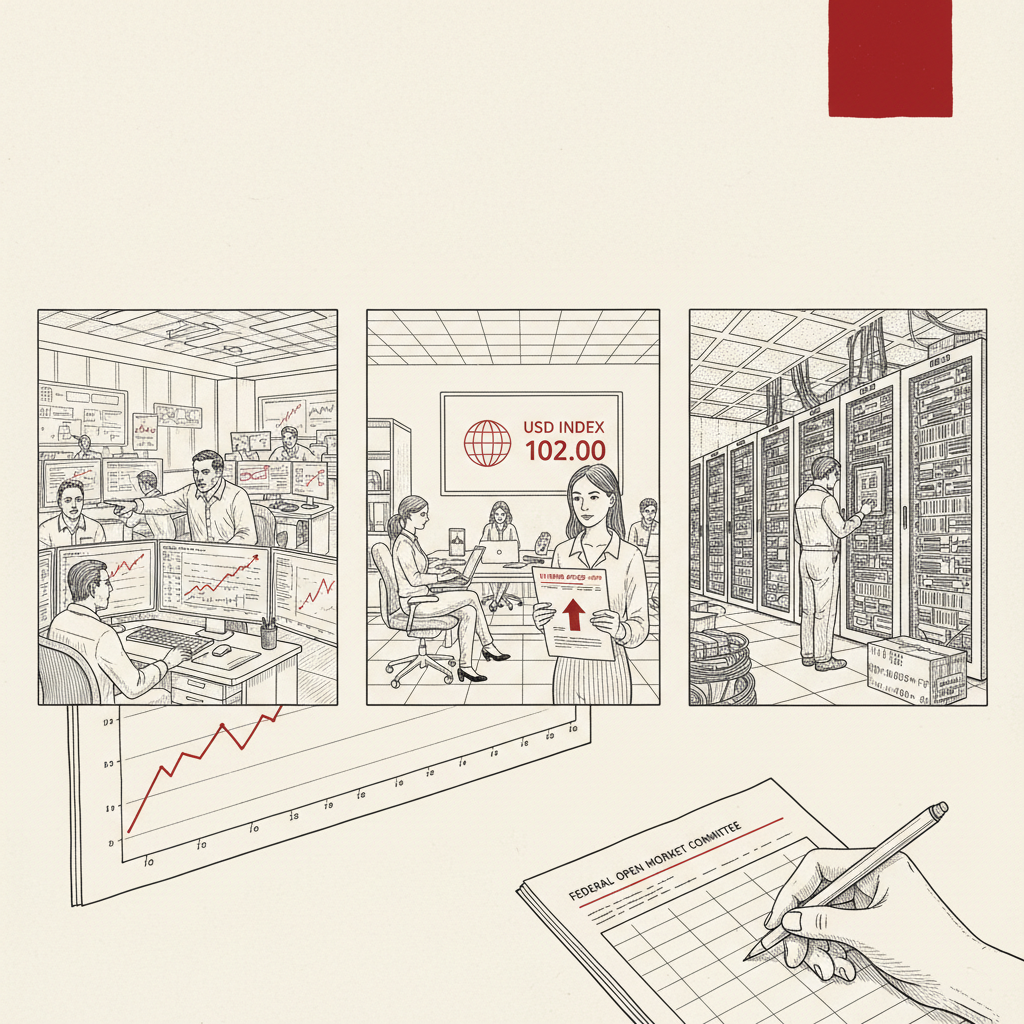
A sharp rise in government bond yields has emerged as a significant risk for global financial markets. This development occurred in late 2026, according to FX News Group. The US Dollar (USD) Index remained in positive territory near 102.00 in the European morning on October 7, as bond yields recovered. This stabilization of the dollar occurred ahead of the Federal Open Market Committee (FOMC) Minutes.
The details
The Federal Reserve raised interest rates on September 16. The increase was 25 basis points, moving the federal funds rate to a range of 3.75%-4.00%. This marks the first rate hike by the Fed since 2023. This action by the U.S. Federal Reserve has had international repercussions. Three weeks after the U.S. Federal Reserve raised interest rates, Canadian fixed mortgage rates also increased. This demonstrates a direct transmission mechanism where U.S. monetary policy influences borrowing costs in other nations.
The mechanism behind rising bond yields is multifaceted. When the Federal Reserve raises its benchmark interest rate, it typically leads to higher yields on government bonds, such as U.S. Treasuries. This is because newly issued bonds must offer higher yields to remain attractive compared to the increased returns available on other interest-bearing assets. Existing bonds also see their prices fall, which corresponds to an increase in their effective yield, to align with the new, higher rate environment. The market anticipates that the US Monthly Budget Statement for September 2026 will provide data on the fiscal year 2026 deficit. This statement will also offer insights into Treasury yields, according to Admirals. A larger-than-expected deficit could imply increased government borrowing, which can put upward pressure on bond yields as the supply of government debt increases.
Why it matters
Rising bond yields are a critical factor for global financial markets. The Federal Reserve's rate hike decision is expected to be detailed in upcoming minutes. These minutes could also outline the future policy path. The clarity provided by these minutes is crucial for market participants to assess the trajectory of monetary policy and its implications for asset valuations.
The increase in bond yields has several second-order effects. Higher yields mean that the cost of borrowing for governments, corporations, and consumers increases. For governments, this translates to higher interest payments on national debt, potentially impacting fiscal budgets. For corporations, higher borrowing costs can reduce investment and profitability, which may, in turn, affect stock valuations. For consumers, rising mortgage rates, as seen in Canada following the Fed's hike, make housing less affordable and can dampen consumer spending.
Gold prices are currently facing uncertainty regarding their recovery. This is due to questions about whether September's rate hike was sufficient to address inflation or if further tightening is anticipated. Gold, often seen as a safe-haven asset, can be negatively impacted by rising interest rates as it does not offer a yield, making interest-bearing assets more attractive. Conversely, if the market perceives the rate hike as insufficient to curb inflation, gold's appeal as an inflation hedge might increase. The US Dollar stabilized as bond yields recovered ahead of the Federal Open Market Committee (FOMC) Minutes. A stronger dollar can make U.S. exports more expensive and imports cheaper, affecting trade balances and corporate earnings for multinational companies.
In a specific instance, Bank of America raised its price target on a particular S&P 500 stock following the Fed's rate hike, according to TheStreet. This stock was Coinbase. This indicates that while rising rates generally pose challenges, some companies may be perceived as benefiting or being resilient in such an environment, leading to positive analyst revisions. However, the broader market sentiment often shifts towards caution with higher borrowing costs and tighter monetary conditions.
What to watch
A readout of the Federal Reserve's last policy meeting is expected on Wednesday. This readout will detail the rate-hike decision and policy path, according to Reuters. Market participants will scrutinize these minutes for any indications of the Fed's future intentions regarding interest rates, including the possibility of further hikes or a pause. This information is critical for forecasting economic growth, inflation, and investment strategies. The US Monthly Budget Statement for September 2026 will be released. This statement will include fiscal year 2026 deficit data. It will also indicate implications for Treasury yields. The deficit data will provide insight into the government's borrowing needs, which directly influences the supply of Treasury bonds and, consequently, their yields. A larger deficit could signal continued upward pressure on yields, while a smaller deficit might alleviate some of that pressure. These upcoming releases are key for understanding the ongoing dynamics in bond markets and their broader financial implications.
Sources
- Do Rising Bond Yields Signal a Crash? (Part 1) — FX News Group
- US Monthly Budget Statement October 2026: September Deficit Preview — Admirals
- Fed’s rate hike prompts Bank of America to raise price target on S&P 500 stock — www.thestreet.com
- Fed minutes could detail rate-hike decision, policy path — WSAU
- U.S. Fed raises interest rates despite Trump: ‘Important shift’ Canadians must make as fixed mortgage rates respond — Yahoo! Finance Canada
- Forex Today: US Dollar stabilizes as bond yields recover ahead of FOMC Minutes — www.tmgm.com
- Gold Prices Today: Buy the Dip or Wait for Fed Minutes? — INDmoney
Valencia Cross publishes research and commentary for informational purposes only. Nothing here is investment advice. Verify every figure against the linked primary sources.