SoftBank Funds OpenAI Stake with Record Junk Bond Sale
SoftBank issued a record $11 billion junk bond to finance its 13% stake in OpenAI, bringing Masayoshi Son's total AI investment to $64.6 billion. This move occurs amidst rising private credit defaults and broader market instability indicators.
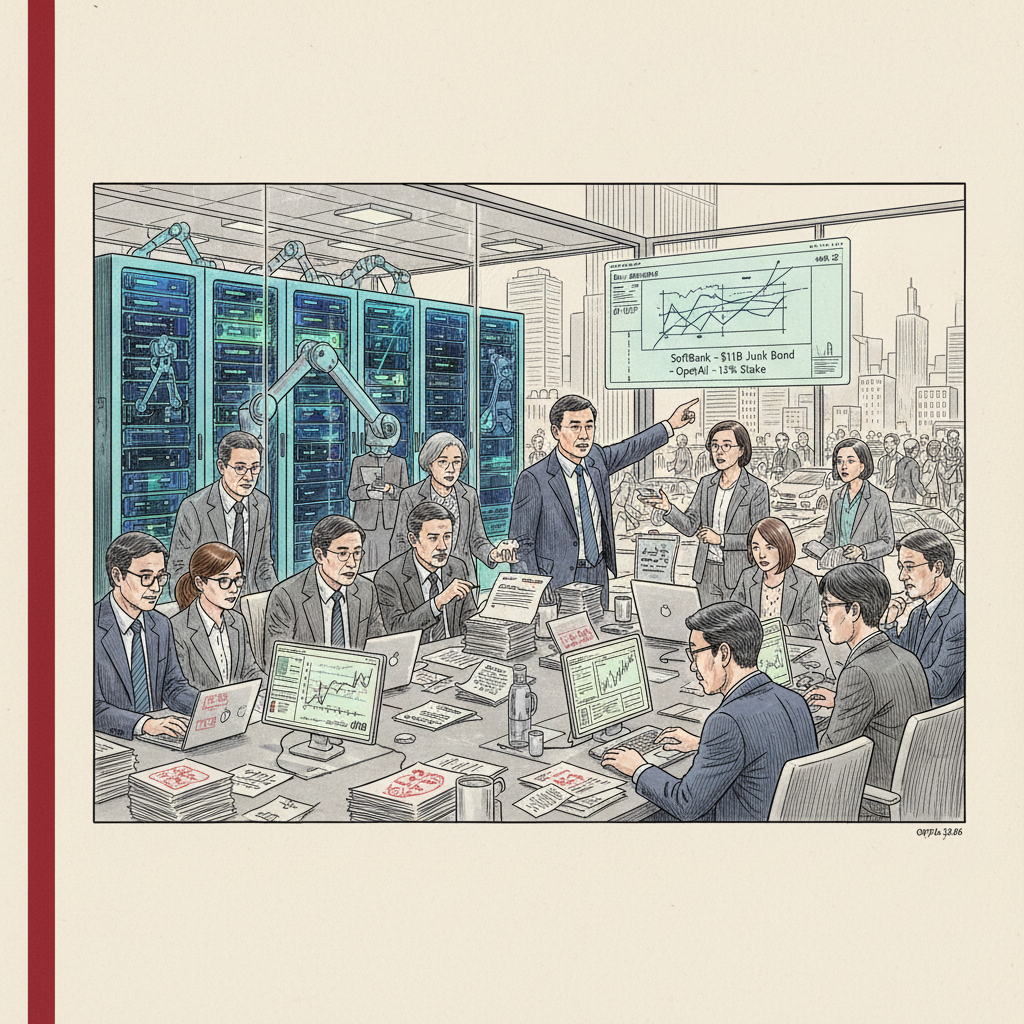
SoftBank launched a record $11 billion junk bond on September 22, 2026. This action funds its 13% stake in OpenAI. Masayoshi Son's cumulative investment in AI reached $64.6 billion.
The details
SoftBank issued a record $11 billion junk bond on September 22, 2026. This bond sale provides capital for its investment in OpenAI. The company holds a 13% stake in OpenAI, an artificial intelligence research and deployment company. This stake is part of Masayoshi Son's larger AI investment strategy, which now totals $64.6 billion across various AI projects.
A junk bond, also known as a high-yield bond, is a debt instrument rated below investment grade by credit rating agencies. These bonds carry a higher risk of default compared to investment-grade bonds, and as a result, they offer higher interest rates to compensate investors for that increased risk. For SoftBank, issuing such a bond allows it to raise a substantial amount of capital quickly, albeit at a higher cost of borrowing. The mechanism involves SoftBank selling these bonds to investors, who then receive periodic interest payments and the return of their principal at maturity. The proceeds from this sale are specifically earmarked to finance the OpenAI stake, indicating a direct link between the high-yield financing and the strategic AI investment.
This $11 billion issuance is notable not only for its size but also for its timing within the broader financial landscape. The market for asset-based lending (ABL) recently demonstrated stable capacity, even as the Federal Reserve implemented interest rate increases. Concurrently, private credit defaults have been on an upward trend. These conditions suggest a bifurcated credit market, where certain segments like ABL remain robust due to collateral-indexed capital, while other areas, particularly private credit, are experiencing stress. SoftBank's decision to tap the junk bond market for such a large sum indicates a willingness to incur higher financing costs to secure its position in the AI sector, potentially reflecting a strong conviction in OpenAI's future value.
Why it matters
SoftBank's junk bond issuance represents a significant financing event, highlighting both the aggressive pursuit of AI investments and the associated financial leverage. The bond funds a substantial stake in a prominent AI company, underscoring the strategic importance SoftBank places on the artificial intelligence sector. This move reflects a continued focus on AI investments by Masayoshi Son, whose cumulative $64.6 billion commitment to AI initiatives demonstrates a long-term vision for the technology's impact.
The scale of the bond sale, at $11 billion, is notable within the high-yield market. The use of a junk bond, by its nature, introduces higher financial risk for SoftBank due to increased debt servicing costs and the potential for refinancing challenges if market conditions deteriorate. This mechanism allows for rapid capital deployment into high-growth, high-potential sectors like AI, but it also increases the company's exposure to interest rate fluctuations and credit market sentiment. Should OpenAI's performance not meet expectations, or if the broader AI market experiences a downturn, SoftBank's ability to service this high-yield debt could be impacted.
Second-order effects of this substantial bond issuance could include a re-evaluation of risk appetite within the broader debt markets. A successful issuance of this magnitude might encourage other companies to pursue similar high-yield financing for strategic investments, potentially contributing to an overall increase in corporate leverage. Conversely, if the market perceives SoftBank's move as overly aggressive, it could lead to increased scrutiny of other highly leveraged companies or those with significant exposure to speculative growth sectors.
The broader financial environment provides context for this action. The Minsky Instability Clock, an indicator that tracks 11 public macro indicators including credit, profits, yield curve, bank lending, and credit spreads, is designed to assess market fragility. An increase in private credit defaults, as reported by ABF Journal, suggests a potential build-up of financial stress in certain segments of the credit market. This rising default rate, coupled with the Federal Reserve's rate hikes, indicates a tightening financial environment where the cost of capital is increasing and risk is being re-priced. SoftBank's decision to issue a junk bond in this climate could be seen as a calculated risk, betting on the outsized returns from AI to offset the higher cost and risk of its financing.
Furthermore, the legal dispute between private equity firm Silver Lake and Carl Icahn, along with other hedge funds, over the Endeavor buyout, illustrates ongoing tensions and complexities in large-scale financial transactions. Silver Lake is suing Icahn and dozens of hedge funds, alleging illegal collusion to fight the $13 billion acquisition. This type of high-stakes legal battle underscores the aggressive tactics and significant capital involved in major corporate deals, providing a backdrop of intense financial maneuvering in which SoftBank's OpenAI investment is situated.
What to watch
Future disclosures regarding SoftBank's financial filings or further investment announcements will provide additional context regarding the performance and strategic direction of its AI portfolio. Any changes in market conditions for junk bonds, including interest rate movements or shifts in investor appetite for high-yield debt, will be relevant to SoftBank's financing costs and its ability to manage this new debt.
Monitoring the performance of OpenAI and the broader AI sector will be crucial, as the success of SoftBank's investment is directly tied to the growth and profitability of these ventures. Developments in the private credit market, specifically continued trends in default rates, will offer insights into the overall health of credit markets and potential systemic risks that could impact SoftBank's financial stability. The Minsky Instability Clock's readings will provide a macro-level perspective on market fragility, which could influence investor sentiment towards high-risk assets like junk bonds and speculative investments in AI.
Additionally, the ongoing legal proceedings involving Silver Lake and Carl Icahn over the Endeavor buyout could set precedents or reveal dynamics pertinent to large-scale private equity and M&A activities, which are often interrelated with the types of investments SoftBank pursues. Observing the crypto market, where Solana recently hit a seven-month high and AI-driven tracking tools are identifying new trends beyond Bitcoin, indicates a broader environment of speculative capital flows and technological innovation that could influence investor sentiment across various high-growth sectors, including AI. Finally, advancements in materials science, such as the mass production of 2D silver powder reducing silver consumption, highlight technological shifts that can impact industrial inputs and potentially create new investment opportunities, indirectly affecting capital allocation strategies in the broader market.
Sources
- SoftBank Launches Record $11 Billion Junk Bond Sale: Masayoshi Son’s $64B AI Bet — The Eastern Herald
- Middle Market Debt Weekly: ABL Capacity Holds Firm as Fed Raises Rates, Private Credit Defaults Climb — ABF Journal
- Minsky Instability Clock [SpokoStocks] — TradingView
- Silver Lake sues Carl Icahn and hedge funds over Endeavor buyout — The Mighty 790 KFGO
- Silver Lake Takes On Carl Icahn and the Merger Arbitrage World in Endeavor Fight — WSJ
- Crypto Rotation Accelerates as Solana Hits Seven-Month High; VOIDTRACE AI Tracks the Next Wave Beyond Bitcoin — StreetInsider
- Silver Prices Surge, Import Dependency Exceeds 90%: Boaosheng Reduces Silver Consumption by 30% With 2D Silver Powder, World's First Mass-Produced Low-Temperature Nano Conductive Silver Paste Launched — eu.36kr.com
Valencia Cross publishes research and commentary for informational purposes only. Nothing here is investment advice. Verify every figure against the linked primary sources.