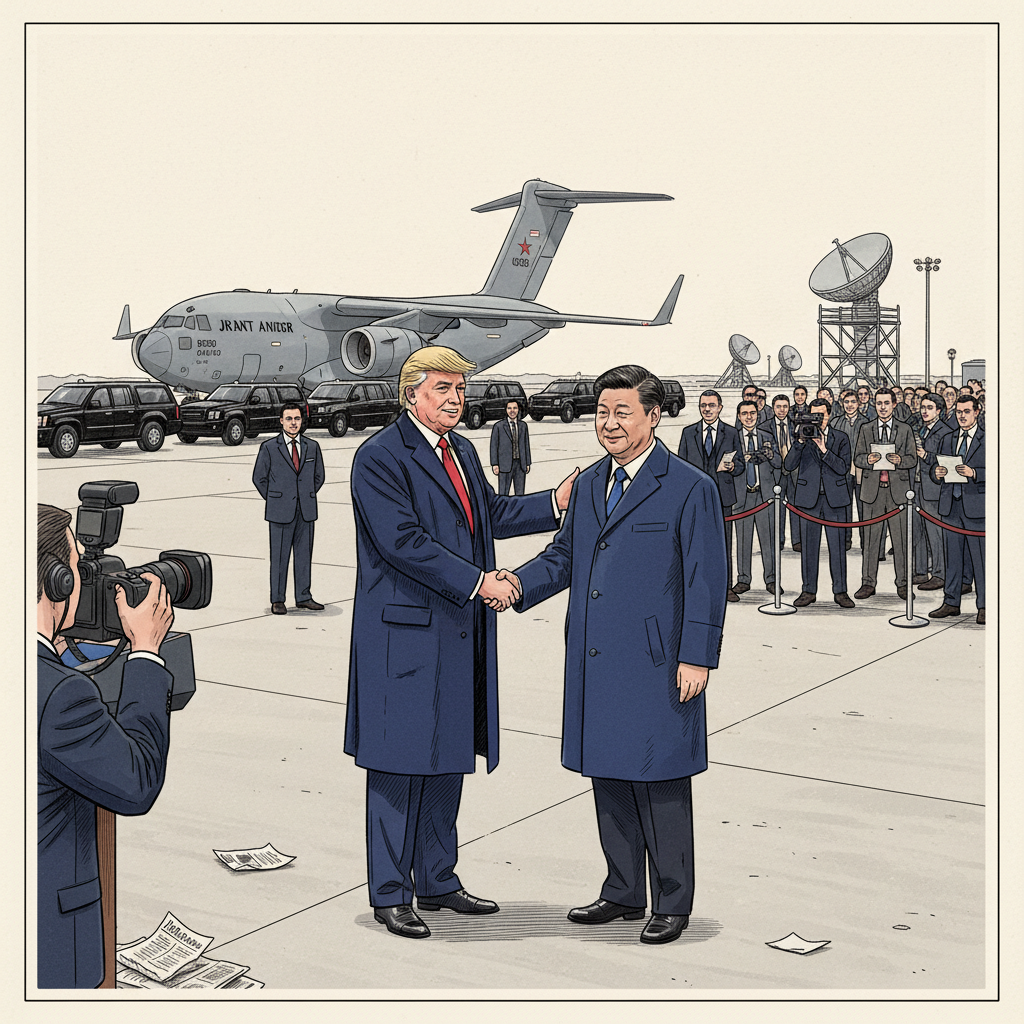
A truce between the United States and China has lowered immediate tensions. This development occurred following a meeting between US President Donald Trump and Chinese President Xi Jinping. President Trump greeted President Xi on September 23, according to The Business Standard. This was the first time a US president welcomed a foreign leader at Joint Base Andrews in 11 years. The meeting aimed to achieve a trade win for the United States.
The details
Demócrata reports that the United States and China agreed to lower tariffs. This agreement covers $30 billion in trade. Both nations also agreed to open a dialogue on artificial intelligence (AI). This represents a new step to reduce trade and technological tension between the two countries. The mechanism for this de-escalation involves direct engagement at the highest levels, culminating in specific agreements on tariffs and a commitment to future discussions on AI. This immediate reduction in tensions, however, is not a comprehensive resolution of all bilateral issues. The Trump-Xi truce addresses immediate concerns but leaves several issues unresolved. These include broader trade disputes, the future of AI development and regulation, geopolitical stances on Iran, energy security, and the status of Taiwan, according to Kashmir Life. The agreement to lower tariffs on $30 billion in goods suggests a partial rollback of previous trade measures, indicating a mutual desire to alleviate economic pressures, at least temporarily. The establishment of an AI dialogue signifies an acknowledgment of the critical and complex nature of this emerging technology in bilateral relations, moving towards a structured discussion rather than unilateral actions.
Why it matters
The reduction in immediate tensions between the US and China may create strategic space. Kashmir Life suggests India could potentially leverage this situation. The mechanism behind this potential opening for India stems from the US and China redirecting some focus from their direct confrontation to implementing the truce and managing the remaining unresolved issues. This shift in focus could temporarily reduce the pressure on other nations to align explicitly with either Washington or Beijing, thereby offering greater diplomatic and economic maneuverability.
Second-order effects of this truce include a potential, albeit temporary, stabilization of global markets that have been impacted by US-China trade tensions. Businesses operating internationally might experience reduced uncertainty regarding tariffs and supply chains, allowing for more predictable planning. For India, this strategic space could manifest in several ways. Economically, a less confrontational US-China relationship might reduce the need for countries to choose between the two economic giants, potentially allowing India to pursue trade and investment opportunities with both without significant geopolitical repercussions. Diplomatically, if the US and China are preoccupied with managing their truce and the unresolved issues, their attention on other regional dynamics might be slightly diminished, providing India with more room to assert its own foreign policy objectives and strengthen regional partnerships without immediate counter-pressures from either superpower. For instance, India could potentially enhance its engagement in multilateral forums or pursue bilateral agreements with other nations, capitalizing on a moment of reduced US-China friction. The unresolved issues between Washington and Beijing indicate that the truce is not a comprehensive resolution. This ongoing complexity in US-China relations could present opportunities for other global actors, including India, to shape regional and international agendas. The agreement on tariffs and AI dialogue signals a partial de-escalation, but the breadth of remaining disagreements suggests continued geopolitical maneuvering, which India might navigate to its advantage.
What to watch
Continued developments regarding trade, AI, Iran, energy, and Taiwan between the US and China will be relevant. The implementation details of the agreed tariff reductions and the progress of the AI dialogue will provide insights into the durability and depth of the truce. Future statements or actions from Washington and Beijing concerning these unresolved areas will provide further clarity on the long-term trajectory of their relationship. Observers should monitor whether the AI dialogue leads to concrete agreements or merely serves as a forum for discussion, as this will indicate the extent of de-escalation in the critical technology sector. Furthermore, any shifts in US or Chinese policy regarding Iran, energy markets, or Taiwan will be crucial indicators of the truce's limitations and potential for renewed tensions. India's diplomatic and economic responses to these evolving dynamics will also be a key area of observation, as it seeks to capitalize on the strategic space created by the Trump-Xi truce.
Sources
- Can India Turn the Trump-Xi Truce Into Strategic Space? — Kashmir Life
- Trump welcomes Xi to Washington looking for a trade win — The Business Standard
- USA and China agree to lower tariffs on 30 billion and open a dialogue on AI — Demócrata
Valencia Cross publishes research and commentary for informational purposes only. Nothing here is investment advice. Verify every figure against the linked primary sources.